Environment Reports
Environment Council Report November 2025
- Activity since last National Council
- The draft Sixth Nitrates Action Programme 2026 to 2029 opened for public consultation on the 28th October and will remain open for submissions until the 1st December. The draft programme and Good Agricultural Practice regulations are available here. Some of the key regulatory proposals are as follows:
- There will be a mandatory requirement on derogation farms to know the farm’s nutrient balance, and it will be encouraged for other farms.
- Improved nutrient distribution on fragmented dairy farms – stocking rate on the holding will be based on the milking platform, if stocking rate too high cattle slurry produced on the holding must be applied outside the milking platform or a lower chemical fertiliser allowance will apply.
- Increased slurry and soiled water storage capacity requirements – it is proposed that the (i) volume of slurry produced will increase to 0.40 m3 from 0.33 m3 per dairy cow per week, and (ii) volume of soiled water will increase to 0.30 m3 from 0.21 m3 per dairy cow per week.
- With the exception of arable land being sown with cover or grass crops by 15th September, post-harvest application of organic fertiliser in the form of sewage sludge or biosolid derived from the treatment of sewage sludge, is proposed to be prohibited in the Barrow catchment and the Slaney & Wexford Harbour catchment from 1st January 2028.
- Expansion of DAFM’s organic nutrient movement database to include all organic manures (including sludge and biosolids).
- With regards to the Nitrates Derogation, there has been significant engagement with Government, European Commission, and MEPS with regards to the ongoing negotiations with the European Commission to secure the retention of a workable nitrates derogation. IFA’s key policy asks are as follows:
- IFA is seeking the retention of the nitrates derogation, but this cannot be with conditionality that effectively locks out some current derogation holders and/or prevents new entrants from obtaining a derogation. This would have potential significant implications on generational renewal within Irish Agriculture.
- Ireland recognises the requirement to comply with the Habitats Directive as part of any Nitrates Action Plan or associated derogation. However, the application of any conditionality relating to the Habitats Directive must be practical and achievable. It must be recognised that any overreach relating to the Habitats Directive could likely have future knock-on implications for other farmers both in Ireland and across Europe.
- Longer review cycles are needed to align with farm investment horizons. On-farm capital investments typically require 7–10-year repayment terms, yet Nitrates Action Programmes are reviewed every 2-4 years, creating uncertainty and undermining farmers’ confidence to invest.
- Farmers are fully committed to improving water quality, but for them to continue to invest and meet higher environmental standards, they need long-term economic certainty.
- On the 4th September Teagasc published a report modelling the environmental and economic impact of not retaining the Nitrates Derogation, the full report is available here. The report estimates that if the derogation is not retained and stocking rates were reduced to 170 kg organic N/ha, farmers would need:
- To cut an average of 27 cows per herd, leading to an average loss of €43,555 (39%) in family farm income, if this adjustment was made by reducing cow numbers only.
- Under this scenario, the wider consequences of a loss of the derogation to the dairy sector could see reduced milk supply and a significant drop in exports, resulting in an annual loss of around €1 billion.
- The report considered other scenarios such as renting land, exporting slurry and contract rearing of dairy heifer replacements but these scenarios have consequences other farming sectors.
- The report also highlights that stricter stocking rate limits may have a disproportion impact on smaller family farms who many struggle to compete with larger family farms, creating economic inequalities.
- Minister for Housing, Local Government and Heritage James Browne and Minister of State for Planning and Local Government John Cummins published draft regulations Planning Exemption for Nutrient Storage Facilities in September. The draft proposals permit farms to add up to 1,500 m3 of nutrient storage, with a new stand-alone tank exemption for up to 1,000 m3, while maintaining required separation distances from neighbouring properties. The draft regulations are undergoing environmental assessment and will then come before the Oireachtas for consideration.
- IFA issues press release seeking Enactment of Planning Exemption for Nutrient Storage Needed Urgently so farmers can apply for TAMS in Tranche 10 which closes on the 5th December.
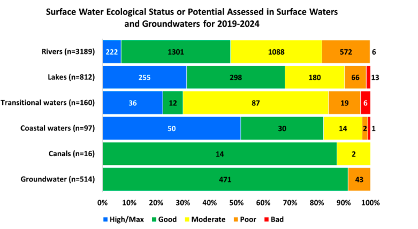
- The EPA published Water Quality in Ireland 2019-2024 report in October, it showed that over half (52%) of our surface waters are in satisfactory ecological health (i.e. good or high ecological status), this is a small decline from the previous assessment when 54% were satisfactory. The full report is available here.
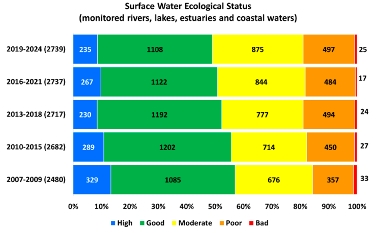
- The number of Rivers in satisfactory ecological status have declined by 2% since the previous reporting period (2016-2021).
- The nitrate concentrations are too high at 44% of rivers sites. these are predominantly located in the east, south east and south of the country.
- On a positive note, (i) the nitrate concentrations have reduced at 39% of sites when compared with 2016-2021, and the total nitrogen levels have reduced significantly over the 2019-2024 period, with nitrogen levels 2024 25% lower than 2019.
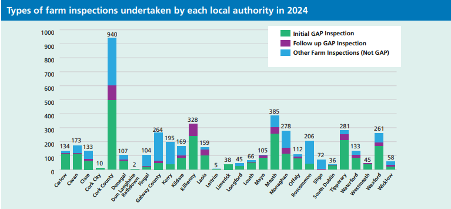
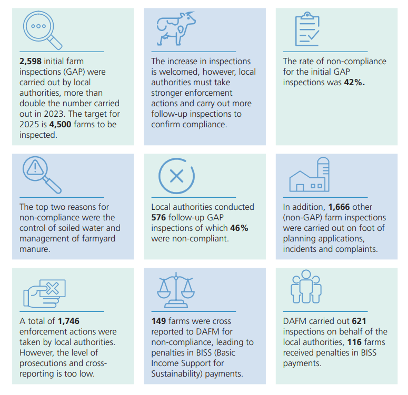
The EPA published the National Agricultural Inspection Programme report 2024 in July. The full summary report is available here. The number of inspections per county and key highlights from the report are as follows:
- Geraldine O’Sullivan, Senior Policy Executive attended the Q3 UÉ National Stakeholder Forum in Limerick on the 15th September, the meeting included an operational tour of the new national laboratory.
- John Murphy, National Environment and Rural Affairs Chair attended pre-consultation workshop on Significant Water Management Issues on Thursday, 23rd October in the Spencer Hotel, Dublin.
- John Murphy, National Environment and Rural Affairs Chair, Tadhg Buckley, Director of Policy and Geraldine O’Sullivan, Senior Policy Executive attended the Teagasc Water Quality conference on the 29th October in Heritage Hotel, Co. Laois.
- The Climate Change Advisory Council (CCAC) published its Annual Review 2025 – Agriculture and Land Use, Land Use Change and Forestry report in July. The full report is available here. The key recommendations in the report are as follows:
- The Government should strengthen incentives, regulations, monitoring systems, and training support to accelerate the achievement of Climate Action Plan 2025 targets, particularly the target of replacing between 80% and 90% of CAN fertiliser with protected urea and set annualised targets for the deployment of methane-reducing manure additives.
- The Government should establish a dedicated unit to accelerate the deployment of nature-based solutions for the management of water resources and flood risk at catchment level.
- The Government should set annual targets for the roll-out of specific diversification measures, including for bioenergy generation, organic production systems, expanding tillage, biodiversity restoration, and increasing afforestation and agroforestry.
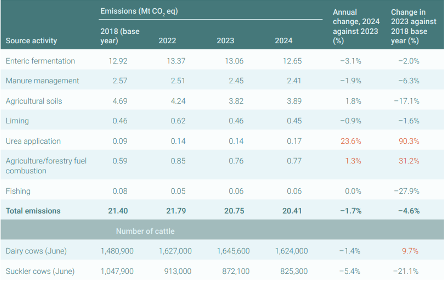
the 2018 baseline.
- The Department of Agriculture, Food and the Marine has opened a public consultation on the Principles for Developing Carbon Farming in Ireland, the public consultation is open for submission until the 30th November. A link the documents are available here.
- John Murphy, National Environment and Rural Affairs Chair, Tadhg Buckley, Director of Policy and Geraldine O’Sullivan, Senior Policy Executive represented IFA at the Joint Oireachtas Committee (JOC) on Climate, Environment & Energy on 2nd October. IFA’s opening statement, On the key barriers that may prevent Ireland from meeting its 2026 – 2030 climate change targets, statement is enclosed.
- IFA has launched a coordinated campaign with ICOS, Irish Fertiliser Manufacturing and Blenders Association (IFMBA) and Acorn Independent Merchant to seek a postponement to the implementation of Carbon Border Adjustment Mechanism (CBAM) on fertilisers, which is due to be introduced in January 2026, as part of campaign a letter was sent to Minister Heydon. See EU/COPA developments for further information.
- IFA prepared a briefing note on Climate Neutrality, and the proposed definition by the Climate Change Advisory Council, briefing note enclosed.
- The EPA published its Quarterly Greenhouse Gas Emissions Indicator Report 2025 Q2 report in October 2025. The full report is available here. Total national emissions decreased by 3.5% (-438.5 kt CO2eq) compared to Q1 2025.
- The report shows that after Buildings sector Agriculture had the largest decrease in emissions of 2.4% (-117.3 kt CO2eq).
- This was driven by the 13.7% decrease in inorganic nitrogen fertiliser sales on the same quarter last year, in combination with a 4.5% decrease in non-dairy cattle numbers leading to reductions in emissions from enteric fermentation and manure management.
- However, when looking year to date (comparing Q2 2024 and Q2 2025) emissions increased by +1.2% (+109.6 kt CO2eq), the largest increase in emissions occurred in the Agricultural soils (+175.1 kt CO2eq) sector (See figure 2).
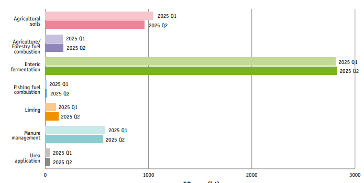
seasonally adjusted data)
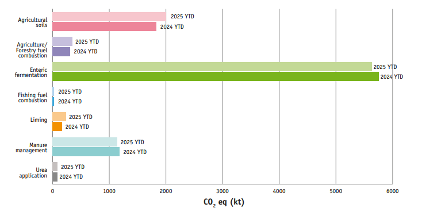
- IFA made a submission to the public consultations on the Sectoral Adaptation Plan 2025 Agriculture, Forestry and Seafood in September, see enclosed.
- John Murphy, National Environment and Rural Affairs Chair and Geraldine O’Sullivan, Senior Policy Executive attended the Signpost Review Workshop on the 16th July in Killeshin Hotel, Portlaoise. The 2025 Signpost report was subsequently published and is available here.
- Geraldine O’Sullivan, Senior Policy Executive attended the Climate KIC Leadership for Future of Agri-Food training day in Airfield Estate, Dublin on the 9th September.
- Tadhg Buckley, Director of Policy and Geraldine O’Sullivan, Senior Policy Executive met with representatives from the Just Transition Commission to discuss a just transition for agriculture on 10th September. The mission of the Just Transition Commission is to support the Government in its responsibility to provide that Ireland’s transition to the National Climate Objective has regard to the requirement for a just transition to a climate neutral economy.
- Geraldine O’Sullivan, Senior Policy Executive attended the online webinar organised by the Institute of International and European Affairs (IIEA) on Denmark’s Green Tripartite Agreement: A New Model for Irelands Agriculture and Climate Policy? on 22ndOctober.
- With regards proposed introduction Extended Producer Requirement (EPR) Scheme for Agricultural tyres, the following actions have been undertaken:
- John Murphy, National Environment and Rural Affairs Chair and Geraldine O’Sullivan, Senior Policy Executive had online meet with representative from the Department of Climate, Energy and the Environment (DCEE) to get status update on the proposed introduction of the environmental levy on agricultural tyres, the proposals are with Minister Cummins for consideration.
- John Murphy, National Environment and Rural Affairs Chair and Geraldine O’Sullivan, Senior Policy Executive met with Circol ELT on the 17th July and 28th October, following first meeting a briefing note on the proposed costs to farmers of the environmental levy was provided (see enclosed), the latest meeting focussed on the roll out of Farm Trye Bring Centres programme.
- The first Farm Tyre Bring Days organised by Circol ELT, will take place on November 20th, 21st and 22nd at Crossmore Recycling, Carrigdownane Upper, Co. Cork (P67 YC99) from 8 am to 4pm daily. Tyres must be clean and free from soil or stones. Rates are €50 per tonne (incl. VAT) for up to 4 tonnes, and €120 per tonne thereafter. Farmers must register in advance at https://circolelt.ie/waste-tyres/farm-tyre-bring-days/.
- An IFA delegation including IFA President met with Fergal Mulligan, Commissioner with the Commission for Regulation of Utilities (CRU) to discuss the planned increase in Non-Domestic Tariff Framework (NDTF) (Water Charges) on the 1st October. It was agreed that IFA would work with Uisce Eireann and CRU to investigate opportunities to introduce flexibilities under the Water Framework Directive to reduce costs for farmers, particularly farmers with multiple connections.
| Metered Tariffs | 2024 Water Service Charges | 2025 Water Service Charges | ||
| Standing Charge (€/yr) | Volumetric Charge (€/m3) | Standing Charge (€/yr) | Volumetric Charge (€/m3) | |
| Band 1 class(<1,000m3) | 83.02 | 2.19 | 91.60 | 2.40 |
| Band 2 class(1,000m3 – 19,999m3) | 218.11 | 1.68 | 239.48 | 1.84 |
| Band 3 class(20,000m3 – 249,999m3) | 3,708.61 | 1.56 | 4,072.05 | 1.71 |
| Band 4 class(250,000m3 – 2,299,999m3) | 41,332.17 | 1.38 | 45,382.72 | 1.52 |
| Band 5 class(250,000m3 – 2,299,999m3) | 295,967.72 | 1.27 | 324,972.56 | 1.39 |
- IFA coordinated for a group of 15 farmers to attend the Farming for the Future Leaders’ Forum on Nature Restoration meeting on the 9th July in Mullingar, Co. Westmeath and John Hardy, IFA Offaly Environment representative participated in panel discussion to outline farmers concerns with regards to the Nature Restoration Plan.
- A new website was launched www.restore.ie to encourage engagement with the process.
- There have been a series of Community Conservations in September and October to engage with communities on proposed Nature Restoration Plan, however no concrete proposals/recommendations were discussed at these events.
- IFA have written to Christopher O’Sullivan, Minister of State at the Department of Housing, Local Government and Heritage to seek a meeting with regards the development of the NRP.
- Geraldine O’Sullivan, Senior Policy Executive attended the Agriculture and Forestry Workshop – Stakeholder Consultation for the 4th National Biodiversity Action Plan on 9th October in the Sheraton Hotel, Athlone.
- Geraldine O’Sullivan, Senior Policy Executive attended the EPA Advisory Committee meeting on Wednesday, 23rd July in EPA HQ in Dublin, this was the third meeting of the year.
- National Environment and Rural Affairs Committee meeting in Farm Centre Dublin on 27th August, agenda topics discussed included: NAP & Derogation update, Climate Act – Climate neutrality target, 6. Environmental levy on agricultural tyres, Carbon Border Adjustment Mechanism (CBAM) and fertiliser prices, Roadmap to Nature Credits consultation and presentation from Irish Farm Films Producers Group (IFFPG)
- Geraldine O’Sullivan, Senior Policy Executive attended the online Irish Farm Films Producers Group (IFFPG) Management Committee meeting on 17th September, the in-person Board meeting on 24th September in Horse and Jockey Hotel, Tipperary.
- Geraldine O’Sullivan, Senior Policy Executive represented IFA as a panellist at the Advancing Agri-PV: The Future of Farming with Solar at the Solar Ireland 2025 conference in the RDS Dublin on the 2nd October.
- Any EU/COPA developments
- In July 2025, the European Commission formally proposed an amendment to the European Climate Law – EU Climate 2040 Regulation – to establish a binding EU target to reduce net greenhouse gas (GHG) emissions by 90% by 2040 (relative to 1990 levels).
- The proposal builds on the 2030 target (at least 55% reduction by 2030) and the legally binding objective of climate neutrality by 2050 already enshrined in EU Climate Law. The Commission’s proposal is now with the European Parliament and the Council of the European Union for discussion under the ordinary legislative procedure.
- The European Parliament’s Committee on Environment vote will most likely be held on 14 November, with the plenary session scheduled for 24 November. The European People’s Party (EPP) remains quite divided in its position, which explains the prolonged negotiations on the compromise amendments.
- Key technical elements include allowance for limited use of international carbon credits and an increased role for domestic carbon removals (e.g., land-use, forestry, negative-emissions technologies) in meeting the target.
- The central concern is the potential negative impact on farm income and the sector’s competitiveness, especially against imported products with less strict environmental standards. While new mechanisms like carbon farming offer potential income streams, there is significant concern over how new climate-related costs will be financed.
- Farm organisations, like COPA (which IFA are a member) are seeking assurances of long-term adequate and stable funding outside of the CAP.
- Geraldine O’Sullivan, Senior Policy Executive attended the COPA briefing on the EU Climate Law and 2040 Climate Target on the 17th September.
- The EU Soil Monitoring and Resilience Directive (commonly called the Soil Monitoring Law) was passed by the European Parliament in October 2025. The goal is to ensure all EU soils are in a “healthy condition” by 2050 through a common framework for soil monitoring, data collection, and management.
- Healthy soils are defined as: “A soil whose structure, composition and functions allow it to provide ecosystem services and perform key ecological, economic and social functions, without causing harm to human health or the environment.”
- The key objective is to establish an EU-wide system to monitor soil health using agreed indicators. The Commission will work with Ireland to set thresholds for each indicator – expected by 2027
- Eight indicators will assess soil health: (i) soil organic carbon, (ii) soil structure & compaction, (iii) nutrient balance (N & P), (iv) erosion, (v) biodiversity, (vi) salinisation & acidification, (vii) contamination and (viii) land take & sealing.
- A soil will be classified as “healthy” if it meets the minimum conditions for maintaining its main ecosystem functions — even if not every indicator is optimal.
- The timeline for implementation is (i) establish national monitoring frameworks (2026–2028), (ii) first soil health mapping and reporting in Ireland (2028–2030) and (iii) ongoing monitoring, reporting every 5 years, and action to restore degraded soils (2030 onwards).
- As part of IFA’s campaign to seek a postponement to the implementation of Carbon Border Adjustment Mechanism (CBAM) on fertilisers on the 1st January 2026, a letter issued to Commissioner Wopke Hoekstra for Climate, Net Zero and Clean Growth and Commissioner Christophe Hansen for Agriculture and Food. In the letter a number of legislative flaws have been identified (i) timely actual emissions values unavailable turning CBAM into an import tariff, (ii) unworkable certificate pricing system preventing timely cost calculation, and (iii) risk of CBAM circumvention via importation of fertiliser from Northern Ireland. We also highlighted implementation issues such as (i) delayed publication of CBAM benchmarks until 2026 and (ii) unpublished default emissions for the definitive period.
- IFA made a submission to the IFA submission to European Commission consultation on Roadmap to Nature Credits on the 30thSeptember, submission to the consultation enclosed.
- John Murphy, National Environment and Rural Affairs Chair and Geraldine O’Sullivan, Senior Policy Executive attended online COPA Environment Working Party meeting on 30th October.
- Upcoming issues
- IFA will hold a National Nitrates Derogation meeting on 3rd November at 7.30pm in Corrin Mart, Fermoy. The meeting with be addressed by Minister Heydon.
- IFA will prepare a submission to the draft Sixth Nitrates Action Programme.
- IFA will prepare a submission to the Principles for Developing Carbon Farming in Ireland.
- The next National Environment and Rural Affairs Committee meeting will take place on the 27th November in the Farm Centre.
- IFA will continue to lobby to secure a postponement to the CBAM for fertilisers.
- IFA will respond and consider policy implications of COPA LULUCF survey.