Livestock Reports
Livestock Council Report February 2026
Market Report
- Beef Price: Steers are making from €7.00kg to €7.20/kg. Heifers are making €7.10/kg to €7.30/kg with higher deals for larger lots and increased off season breed bonuses paid. Young Bulls are ranging from €7.20kg to €7.50/kg for R/U grades. Cows are making €6.30kg to €7.00/kg.
- DAFM Reported Prices week ending 25/01//2025: R3 steer prices for the latest week increased by 1c/kg to €7.42/kg, R3 heifer price decreased by 1c/kg to €7.46/kg. R3 young bull prices increased by 22c/kg to €7.35/kg. O3 grading cows are up 5c/kg to €6.57/kg, R3 grading cows are back 2c/kg to €6.92/kg.
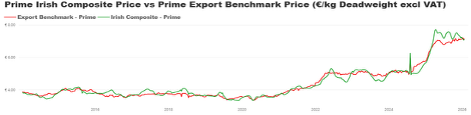
- Composite prices: The latest Irish prime composite cattle price and the prime Export Benchmark on January 24th, 2026, were equivalent to €7.09kg and €7.15/kg deadweight respectfully.
Composite prices: The latest Irish prime composite cattle price and the prime Export Benchmark on January 24th, 2026, were equivalent to €7.09kg and €7.15/kg deadweight respectfully.

| Supply Figures as Reported by DAFM – WK 05 (31.01.2026) | |||||
| Animal | Number | Change prev wk | % of total | YTD | YTD Change |
| Y Bulls | 3,526 | ▲54 | 11% | 15,793 | ▼-438 |
| Bull | 299 | ▲1 | 1% | 1,323 | ▼-114 |
| Steer | 9,707 | ▼-29 | 31% | 49,133 | ▼-9,404 |
| Cow | 7,316 | ▲302 | 24% | 29,919 | ▼-8,590 |
| Heifer | 9,883 | ▲63 | 32% | 49,005 | ▼-7,776 |
| Veal-V | 8 | ▼-4 | 0% | 81 | ▼-68 |
| Veal-Z | 167 | ▲38 | 1% | 788 | ▲236 |
| Total | 30,906 | ▲425 | 100% | 146,042 | ▼-26,154 |
- Supplies: Total throughput to date in 2026 stands at 146,042 head, back 26,154 head from the corresponding week in 2025.
- Market Conditions:
- Cattle prices have steadied over the past few weeks with strong appetite from factories for all categories of cattle. The forecasted slaughter for 2026 is expected to be 1.56-1.6m/head similar to 2025 figures. No recovery in cattle slaughter numbers is expected in 2026. 2025 throughput figures were back over 200,000 on 2024 figures. Prices in GB for R3 steers is £6.44p/kg. R3 Heifers price is £6.43/kg for week ending February 4th, 2026. EU young bull price currently stands at €7.26c/kg.
- Live Exports: A total of 9,189 live cattle have been exported in 2026 to date back 4,324 head on 2025 figures. 2,458 weanlings, 1,060 stores, 1,117 calves and 4,554 finished cattle have been exported to date. Lower live cattle export numbers to date in 2026 are largely attributed to adverse weather conditions and ongoing animal health challenges, including bluetongue restrictions which have disrupted trade flows.
Budget 2026
- IFA have secured 28m for the continuation of a National Suckler Scheme in budget 2026.
- IFA have secured the continuation of a Dairy Beef Calf Scheme for 2026 worth €4m.
- IFA have met with the DAFM on both schemes to ensure they are practical to implement and to avoid unnecessary leakage of monies or administration bureaucracy for farmers.
Suckler Carbon Efficiency Programme
- A funding allocation of €52m was provided for the SCEP scheme in 2023 with a payment of €150 per suckler cow available on the first 22 cows and €120/cow on the remainder.
- 15,800 farmers are currently participating in the scheme with an average reference number of 25 cows. There are currently 435,000 cows eligible for payment.
- Payments for the scheme were issued to farmers in December 2025.
National Beef Welfare Scheme 2025
- IFA secured an additional €8m towards the National Beef Welfare Scheme for 2025, bringing the total budget to €28m for the National Exchequer Suckler Cow Scheme.
- IFA met directly with the Minister and DAFM officials to demand that linear cuts be reversed, clearly setting out the serious impact these reductions will have on suckler farmers.
- 100% payments were issued to farmers in December 2025.
Dairy Calf Beef Scheme 2025
- IFA secured €4m in funding for a Dairy Calf Beef Scheme for 2025.
- IFA engaged directly with the Minister for Agriculture and his officials to demand that the linear cuts applied to the scheme be reversed immediately clearly outlining the serious impact these will have on calf rearers.
- 100% payments were issued to farmers in December 2025.
Mercosur
- IFA and Irish Farmers Journal travelled to Brazil to investigate beef production standards in late October/early November. The investigation found that prescription only, critically important veterinary antibiotics could be purchased freely without prescription or oversight and that there is no effective national cattle identification or traceability system in place for Brazil’s national cattle herd. Farm, mart and slaughter plant visits revealed widespread deficiencies in animal tagging and record keeping. These findings fundamentally contradict claims of equivalence under the EU-Mercosur agreement and raise serious concerns regarding public health, food safety and the impact on Irish and EU livestock farmers.
- The EU and Mercosur bloc signed the trade and partnership agreement in January.
- Despite the agreement, it has not come into force as it must gain consent from the EU parliament.
- EU MEP’s have voted to refer the deal to the European Court of Justice over legal and procedural issues.
- Outline of Mercosur trade deal for Beef:
- 99,000 tonnes of beef at 7.5% duty. In addition, all duties will be immediately removed from the 67,250 tonne Hilton beef quota already available to Mercosur countries currently at a 20% duty rate.
- Economic Impact of Mercosur Trade on Irish Agriculture:
- The above quotas, will most likely be filled only by high-value cuts/products which have the potential to significantly damage the Irish beef sector.
- The deal will lead to tariff reductions for the Mercosur countries in the region of €400m per annum.
- The reduction in EU beef market output will be approximately €1.3bn, with a representative hit of €100-130m to the Irish beef sector. This is equivalent to €75-€95 per head across our prime cattle kill.
- It is frequently claimed that the new 99,000 tonnes quota represents only 1.5% of the EU beef market. This statistic is disingenuous, if the Mercosur countries target the high value steak market, it is equivalent to bringing an additional 4m cattle onto the EU market.
EUDR (EU Deforestation Regulation)
- IFA has been engaging with the relevant bodies and has strongly pushed for changes to simplify the regulation for farmers.
- IFA has sought a simplified requirement at EU level for effectively non risk countries.
- The EU commission has come forward with amended proposed targeted adjustments to the regulation to ensure a smooth implementation of the EU Deforestation regulation aiming to make its IT system fully operational while simplifying obligations for small operators.
- The proposals aim to reduce reporting requirements by limiting due diligence submissions to the first market entry point meaning traders and manufacturers will no longer need to file separate statements.
- Micro and small operators from low-risk countries would only need to make a simple one-off declaration further easing the burden.
EU/COPA Developments
- IFA attended the COPA working party meeting on Breeding livestock in November.
- IFA attended the Civil Dialogue Group on beef in November.
- IFA attended the COPA working party meeting on Beef and Veal in November.
- IFA Livestock Chair Declan Hanrahan was elected Vice-Chair of the COPA working party on beef.
- IFA attended a series of protests in Brussels on Mercosur and CAP in December.