Pig Council Report November 2025
Market Report
When the last council report was submitted in July prices (including vat) were as follows:
Rosderra €2.26 – 2.32c/kg
Kepak €2.26 –2.30c/kg
Dawn P&B €2.26- 2.32c/kg
Staunton’s €2.26 – 2.30c/kg
Sows €1.45/kg
Today, as we enter the month of November, the average pig price reported by Irish pig farmers is €1.86/kg including VAT.
Kepak €1.86 –1.90c/kg
Dawn P&B €1.86- 1.90c/kg
Staunton’s €1.86 – 1.90c/kg
Sows €1.15/kg
Since the early Fridays in July, Irish pigmeat prices, as well as European prices, have fallen dramatically in what has been crowned as unprecedented price drops. There has been a total of 36c/kg drop in prices paid to farmers since the 7th of July which has put significant pressure on Irish pig farmers’ margins nearing them dangerously close to breakeven levels again. For the first 6 months of the year, the Irish pigmeat sector has demonstrated a strong performance, but despite the market having seen a steady increase in production, export value, and domestic retail performance – prices have fallen significantly.
Irish pig throughput year-to-date (YTD) is up 4% compared to 2024. Up to week 38, 2.44 million pigs have been processed, roughly 83,000 head ahead of the same period last year. Week 43 saw 68,277 pigs slaughtered, including 2,088 of which were sows.
Live exports to Northern Ireland are up 12.56% year to date but the demand does seem to be falling a little over the past few weeks.
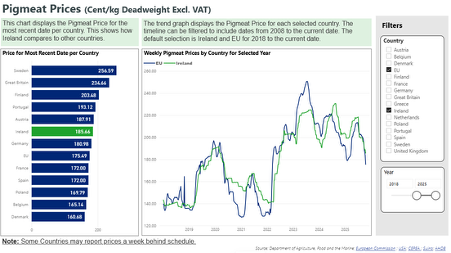
For Grade E pig carcasses, the EU weighted-average price for the week ending 11 October 2025 stood at roughly €1.59/kg, or about €159/100 kg, representing a continuing downward trend across the bloc. In comparison, Irish producers achieved an average of approximately €1.89/kg, or about €189/100 kg, for the same week. Although Ireland’s price remains above the EU average, the gap has narrowed, and both are well down on their earlier-year levels. The stronger relative position for Ireland indicates some national premium remains, but the alignment in trend underscores the fact that export-driven cost pressures and weak external demand are broadly impacting the market, not just domestically. The Chinese tariffs which apply to EU pigmeat exports into China are not helping matters although the through impact of this is not knows presently.
From January to July 2025, Irish pigmeat exports recorded growth in both value (+0.5 %) and volume (+2.5 %). There was a notable shift in trade patterns, with higher exports to the UK (+15 % to €98 million) and Oceania (+48 % to €27 million), partially offset by declines to EU markets (–24 % to €48 million) and North America (–17 % to €12 million).
This reflects changing demand and the sector’s efforts to diversify outlets amid geopolitical and disease-related challenges affecting wider EU trade flows.
Across the EU, pigmeat supply has tightened slightly, with a 1 % fall in total pig population and a 3.4 % reduction in the sow herd. Denmark and Germany have shown some herd recovery, while production in Poland, Italy and Spain faces disease-driven contraction. Tight supplies of poultry and beef, combined with favourable early-season barbecue demand and stronger Chinese import activity, lifted EU pig prices above seasonal norms in mid-2025. However, Germany’s loss of around half its export markets following late-2024 FMD and ASF outbreaks, together with ongoing trade uncertainty, continue to weigh on the longer-term outlook.
At home, retail data from Kantar Worldpanel show steady engagement with pigmeat products. Over the 12 weeks to early September 2025, pork, bacon, and cooked ham all gained market share, partly at beef’s expense, as consumers responded to value and convenience. Bord Bia’s Quality Mark Pork & Bacon campaign, targeting 35- to 65-year-old female shoppers, has helped sustain demand, highlighting Irish origin, flavour, and ease of cooking through TV, radio, and online media. Retail compliance with Quality Mark facings remains high across major outlets, supporting confidence in home-produced pigmeat and underpinning the sector’s positive reputation with consumers.
Activity since last National Council
- The IFA National Pig Farmer meeting was held on September 29th to address the ongoing pressure on producer prices and continuing difficulties around Nitrates compliance, particularly the impractical four-day slurry export notification rule. Ted Massey (Nitrates Division, DAFM) attended the meeting to hear farmer concerns directly. The Committee will meet with him again in the coming weeks to pursue a workable solution for the pig sector.
- Engagement continues with the Nitrates Division on the proposed four-day rule, with the Committee stressing the logistical impossibility of the measure for integrated pig units and live slurry movements.
- Ongoing discussions are taking place with DAFM, Animal Health Ireland, the EPA, Meat Industry Ireland, processors (on pricing mechanisms), and Bord Bia to address immediate market challenges and promote long-term sector viability.
- Continued close cooperation with the Food Regulator, Niamh Lenahan, to strengthen transparency and fairness in the pigmeat supply chain.
- DNA testing and traceability work continues in the foodservice sector to ensure Irish-produced pigmeat is used wherever possible. The Committee has renewed focus on retail compliance and visibility of Quality Assured Irish product.
- Retail engagement remains active on pricing, sustainability, and evolving production standards to ensure the viability of domestic pig farming.
- Ongoing technical discussions with the EPA regarding IED implementation, online reporting, and necessary amendments to the AER template.
- The EIP pilot project on PRRS (Cavan/Donegal) has progressed steadily since summer, in partnership with Teagasc, and will serve as a key model for improving herd health and biosecurity management nationally.
EU/COPA Developments
- Continued collaboration with Copa-Cogeca and the European Commission on simplifying the
implementation of the Industrial Emissions Directive (IED) to reduce administrative burdens on
pig farmers.
- Ongoing engagement with Copa-Cogeca on the revision of the Animal Welfare in Transport Regulation, contributing to position papers to ensure practicality for Irish producers.
- Active involvement in discussions on EFSA’s recommendations on pig welfare, ensuring that farmer-led positions are reflected in forthcoming EU policy proposals.
- Monitoring the “End of Cages” initiative, with Copa-Cogeca’s impact assessment warning that an immediate implementation could remove up to 37 % of EU pork output and 3 % of egg production, underlining the need for phased, realistic transition periods.
- Engagement with Copa-Cogeca and DAFM on the EU Deforestation Regulation (EUDR), is now postponed to January 2026. The IFA is emphasizing the importance of safeguarding feed supply chains, particularly for imported soy used in pig rations.
- Participation continues in the EU Horizon “WelFarmers” project, where IFA pig representatives are contributing to thematic groups on farm welfare practices and knowledge exchange across regions.
Upcoming issues
- We are working on arranging a follow-up meeting with the Nitrates Division (DAFM) to secure practical amendments to the four-day slurry export rule and agree an alternative reporting mechanism for pig units following on from the National meeting.
- Market pressures persist: the average Irish pig price is currently around €1.86/kg. The Committee will continue engaging with processors to push for fairer price returns and transparency in contract structures.
- Renewed focus on reducing imported pigmeat use in the foodservice sector and improving presentation and promotion of Irish pigmeat on retail shelves.
- Continued collaboration with Bord Bia on the revised Pigmeat Quality Assurance Scheme and rollout of pilot audits, while promoting farmer participation.
- Ongoing engagement with the EPA on emissions, IED reviews, and AER template updates to streamline compliance.
- Active participation in the Pig Health Check Implementation Group, particularly in relation to the National Salmonella Control Programme and the Biosecurity Code of Practice.
- Continued work with the DAFM Welfare Division to ensure practical implementation of welfare policy that protects both animal wellbeing and farm sustainability.