Pigs Council Report July 2025
Market Report
When the last council report was submitted in March, prices (including vat) were as follows:
Rosderra €2.10 – 2.14c/kg
Kepak €2.12 –2.14c/kg
Dawn P&B €2.12- 2.14c/kg
Staunton’s €2.08 – 2.10c/kg
Sows €1.20/kg
Today, as we enter the month of July, the average pig price reported by Irish pig farmers is €2.28/kg including VAT.
Rosderra €2.26 – 2.32c/kg
Kepak €2.26 –2.30c/kg
Dawn P&B €2.26- 2.32c/kg
Staunton’s €2.26 – 2.30c/kg
Sows €1.45/kg
The Irish pigmeat sector has demonstrated a strong performance for the first half of 2025. The market has seen a steady increase in production, export value, and overall price stability, despite facing challenges, such as international competition and evolving trade dynamics.
Irish pig throughput year-to-date (YTD) is up 3% compared to 2024, with 1,416,271 pigs processed so far this year. Week 22 saw 65,023 pigs slaughtered, including 1,634 sows.
Live exports to Northern Ireland remain strong, up 32%, further supporting market balance.
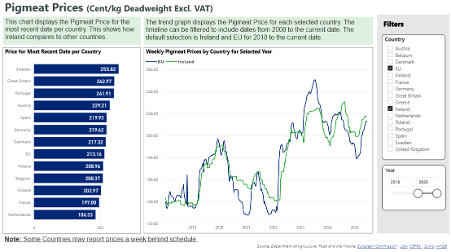
The average Irish grade E pig price for the week ending May 31st was €2.17/kg (excl. VAT). This is marginally 1c/kg lower than the same week last year (€2.18/kg).
EU average prices have strengthened since the start of the year, reaching €2.08/kg most recently.
The EU pig population has declined by 1%, with sow herds down 3.4%, tightening overall supply. Some countries like Germany and Denmark are expanding modestly, but herd declines continue in the Netherlands (-14% yoy), Poland, Italy, and Spain, driven by disease pressures.
Overall EU production is forecast to decline by -1.5% in 2025, despite a slight increase in slaughterings (+1.3%) in early 2025.
Irish pigmeat exports grew in both value (+3%) and volume (+4%) in Q1 2025.
Strong growth was recorded in: UK (+20% to €40m), Asia (+5% to €40m) and Oceania (+36% to €12m). Exports to EU markets fell by 24% and to North America by 6%.
Retail sales data (Kantar) shows continued strong consumer engagement with pork in Ireland. Fresh pork saw the largest volume growth (+10.7%) and strong value growth (+6.8%), Bacon rashers experienced solid growth in both value (+5.9%) and volume (+5.2%), showing stable demand,
and sausages posted a 6.9% volume increase alongside a 5.5% rise in value, suggesting higher consumer uptake potentially driven by affordability and convenience.
Bord Bia’s upcoming pork and bacon TV, radio, and social campaigns in July–August will target increased domestic consumption, focusing on ease of cooking and quality assurance messaging.
The official ‘average’ Irish price quoted by Bord Bia as of June 14th was €2.17 excluding VAT. The average European pig price for the Grade E carcass was quoted as €2/kg dead weight for the same week excluding VAT.
Activity since last National Council
- IFA Pig Committee representatives are actively engaging with the Nitrates Division on the 4day export notification proposal from DAFM as this would be totally unworkable for pig farmers.
- Ongoing engagement with the Department, Animal Health Ireland, Environmental Protection Agency, Meat Industry Ireland, the processors and Bord Bia.
- Engagements with the Food Regulator, Niamh Lenahan, who we will be working closely with over the coming year.
- Ongoing work with the DNA scheme and testing, particularly the foodservice sector, as we work towards ensuring as much Irish product as possible is utilised on home soil. The committee has also refocused efforts on the retail shelf to ensure quality assured Irish produce is delivered to our valued consumers.
- Meeting with retailers on specific issues relating to price, changes in production systems, sustainability and viability of the sector.
- Ongoing discussions with EPA on various issues, technical amendments online and IED.
- Development of the pilot EIP project to focus on PRRS and its rollout in Cavan / Donegal from July/August alongside Teagasc.
EU/COPA developments
- We will continue to work with Copa and Cogeca and the Commission on the implementation of the IED to ensure it is as simplified as possible.
- Engaging directly with Copa and Cogeca on the revision of Animal Welfare in Transport Regulation – ongoing with the development of position papers.
- Last year the European Food Safety Authority released its recommendations for the welfare of pigs on farm. We are actively engaging with Copa-Cogeca to ensure that a strong position is held among farm organisations to lobby on these recommendations.
- End of cages – presentation of study’s conclusions. Copa-Cogeca have conducted an impact assessment on the end of cages and the potential impact associated with the change for agriculture and associated transition periods. Should this come into immediate effect by 2025, it’s expected that circa 37% of pork meat would cease and 3% of EU egg production would cease.
- Engaging with Copa-Cogeca and at national level on the EUD, R which has now been halted until January 2026. However, we will engage with DAFM on the matter as imports of soy will be an important one for pigs.
- EU Horizon project – WelFarmers – IFA is taking part in a EU welfare project on pig welfare which is a 3-year project. Representatives from the pig committee are taking part in ongoing initiatives with this project, as well as being part of the thematic groups and regional networks.
Upcoming issues
- Engagement with DAFM on slurry exports – 4day rule proposal by DAFM and establishment of an alternative method of reporting for pig farmers.
- A reduction in the use of imported pigmeat in the foodservice sector is something the committee is eager to work on and see improvements in.
- Improve presentation of certain pigmeat products on the retail shelves.
- Actively engaging and working to ensure fair price is being returned to producers.
- Engaging with Bord Bia on the revision of a Quality Assurance Scheme and encouraging farmers to participate in the pilot audits.
- Engaging with the EPA regarding various issues including emissions, the revision of the AER template and IED.
- Engaging with the Pig Health Check Implementation Group on the National Salmonella Control Programme and on the Biosecurity code of practice.
- Engagements with the DAFM welfare division on various issues to ensure the welfare of our pigs.