Livestock Reports
Livestock Council Report July 2025
Market Report
- Beef Price: Steers are making from €7.20kg to €7.30/kg. Heifers are making €7.30/kg to €7.40/kg with higher deals for larger lots and increased off season breed bonuses paid. Young Bulls are ranging from €7.40kg to €7.60/kg for R/U grades. Cows are making €6.40kg to €7.20/kg.
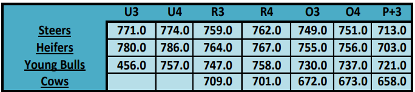
- DAFM Reported Prices week ending 29/06//2025: R3 steer prices for the latest week decreased 8c/kg to €7.59/kg, R3 heifer price decreased by 10c/kg to €7.64/kg. R3 young bull prices decreased by 5c/kg to €7.47/kg. O3 grading cows are back 3c/kg to €6.72/kg, R3 grading cows are back 8c/kg to €7.09/kg.
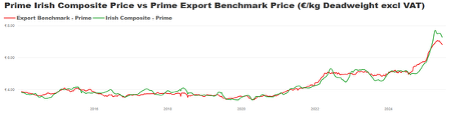
Composite prices: The latest Irish prime composite cattle price and the prime Export Benchmark on June 21st 2025 were equivalent to €7.28kg and €6.82/kg deadweight respectfully.

| Supply Figures as Reported by DAFM – WK 26 (29.06.2025) | |||||
| Animal | Number | Change prev wk | % of total | YTD | YTD Change |
| Y Bulls | 2,937 | ▲90 | 10% | 62,227 | ▼-2,859 |
| Bull | 469 | ▼-100 | 2% | 12,739 | ▼-1,344 |
| Steer | 10,409 | ▲545 | 36% | 318,524 | ▲11,605 |
| Cow | 6,577 | ▼-570 | 23% | 196,807 | ▼-19,450 |
| Heifer | 8,570 | ▲178 | 30% | 277,423 | ▲24,728 |
| Veal-V | 28 | ▲20 | 0% | 2,699 | ▼-16,453 |
| Veal-Z | 24 | ▼-10 | 0% | 1,551 | ▲416 |
| Total | 29,014 | ▲153 | 100% | 871,970 | ▲3,665 |
- Supplies: Total throughput to date in 2025 stands at 871,970 head, up 3,665 head from the corresponding week in 2024. The Irish cattle kill is projected to be back 5% in 2025. The total kill is projected to fall to 87,000 head, which is made up of prime cattle 64,000 head, cows 8,000 head and other 15,000 head.
- Market Conditions: Irish cattle prices remain strong, with prices holding firm or rising. Strong consumer demand and the tightening availability of finished cattle supplies are contributing the strong prices. Supplies have also tightened in the UK and prices have firmed as a result. Prices in GB for R3 steers is 6.42p/kg. R3 Heifers price is £6.40/kg for week ending June 28th 2025. EU young bull price currently stands at €6.23c/kg.
- Live Exports: Live exports of weanling, store, calves, and adult cattle have performed very strong in 2025 to date. Strong demand and tight supplies across Europe due to disease restrictions and price differentials have benefited the Irish trade to date. A total of 283,357 cattle has been exported to date, which is up 25,681 or 14% from the same period in 2024. 30,644 head have been exported to Northern Ireland, 242,281 to mainland Europe an 10,707 to third countries. The outlook for 2025 remains strong for live exports.
Activity since last National Council
- Budget 2026
Suckler Cow Supports
- Direct supports for suckler farmers must be increased to a minimum of €300/cow to provide economic viability, long-term sustainability, and generational renewal within the sector and to maintain its positive contribution to our climate target ambitions and drive of the socio economic, environmental and biodiversity sustainability of rural Ireland.
- The current National exchequer scheme which provides €75/cow for up to 45 cows must be extended to 2026, with funding increased to deliver €300/cow in combination with SCEP. The scheme must be available for all suckler cows on the farm and eligibility criteria must ensure there is no leakage of this funding from suckler farms.
Beef Calf from Dairy herds Rearing Scheme
- There must be a Dairy Beef Calf Welfare Scheme that provides meaningful incentives for farmers to rear calves from the dairy herd. The scheme must reflect the costs, labour and standards required to maximise performance and viability of this livestock production system. Farmers who follow best practice in this area and who focus on rearing high commercial beef value (CBV) calves should be supported with a payment of €100 per calf for the rearing phase of these animals.
Beef Sustainability Scheme
- Farmers rearing and finishing weanling and store cattle born in suckler and dairy herds must be directly supported for this phase of the process, with a minimum of €100/animal to support measures that maximise the performance of these animals. Young Bull finishers have the potential to positively impact on the average age of slaughter of all prime cattle and must be supported in addition to the €100 payment reflecting this high-cost specialist production system.
Straw Incorporation Scheme for livestock and Sheep farmers
- Livestock farmers who utilise native straw for the bedding of cattle and sheep are providing optimum animal welfare conditions in the management of their animals over the winter months at, in the majority of cases, an extremely high cost. The majority of suckler and sheep farmers are small scale farm enterprise’s situated long distances from the areas in which tillage crops are grown in the country and where straw is most available. Transport costs for these farmers regularly exceeds the actual cost of the straw.
- To support these farm enterprise’s and support optimum animal management practices on these farms, cattle and sheep farmers purchasing straw for animal bedding should be directly supported for this action and the environmental benefits of this practise be recognised.
- The benefits of incorporating straw into soils is recognised in the CAP Strategic Plans and tillage farmers are rightly supported for this action.
- The level of supports provided to tillage farmers in the SIM scheme should be provided in a separate national scheme, with new funding to livestock and sheep farmers who utilise native straw for bedding their animals and then incorporate it back into the soil on their farms.
2. Review of Bord Bia Origin Green Producer Standard
- IFA continues to engage with Bord Bia on the Origin Green Producer Standard review.
- The next step of the process is pilot audits on farms. Committee members will be involved in the audits in the coming weeks.
- The substantive issue in this process for IFA is to have a simplified-on farm audit process.
3. Suckler Carbon Efficiency Programme
- A funding allocation of €52m was provided for the SCEP scheme in 2023 with a payment of €150 per suckler cow available on the first 22 cows and €120/cow on the remainder.
- 16,450 farmers are currently participating in the scheme with an average reference number of 25 cows. There are currently 441,346 cows eligible for payment.
- Payments for the scheme will be made in December 2025.
4. National Beef Welfare scheme 2025
- IFA has secured an additional €8m towards the National Beef Welfare Scheme for 2025, bringing the total budget to €28m for the national exchequer suckler cow scheme.
- This increase of €8m provides for payments of €75/suckler cow and when combined with the suckler carbon efficiency programme returns of up to €225/suckler cow for 2025.
- IFA raised concerns on the proposed maximum number of eligible animals per farm. IFA has sought the removal of the upper limit on numbers of animals eligible within a herd.
- The maximum payable number of cows in this scheme is 45, up from 40 in last year’s scheme
- The scheme actions include;
- Action 1 – Meal Feeding: €35 per eligible calf up to a maximum of 45 eligible calves.
- Action 2 – Vaccination:€15 per eligible calf up to a maximum of 45 eligible calves.
- Action 3 – Faecal egg testing and 3 silage samples or 2 faecal egg tests.
- The scheme is proposed to open for application in late Q3 2025.
- 100% payments will be made in December 2025.
5. Dairy calf beef scheme 2025
- IFA secured €4m in funding for a new dairy calf beef scheme for 2025.
- The scheme will pay farmers €20/calf up to a maximum 50 calves.
- Applications for the scheme opened in Q2 2025.
- 100% payments will issue to participants in December 2025.
- The scheme will only consist of one action, which will involve weighing the calf and uploading the weights to ICBF by November 1st 2025.
- IFA raised concerns on the maximum number of 50 eligible calves which should be reviewed. Some farmers specialising in rearing diary beef calves have made significant investments to rear large numbers of calves. All farmers rearing dairy beef calves should be eligible for the full support payment on all the calves they rear.
6. Changes to ICBF Indices
- IFA secured significant flexibilities to SCEP requirements related to the indices, ensuring no farmers are negatively impacted by the changes in November.
- Effectively animals now have the benefit of both indices to meet the criteria.
- Female calves born in herds since the new indices were published where they do not meet SCEP eligibility, will be deemed SCEP eligible if the dam was 3,4, or 5 star and the sire 4 and 5 star on the replacement index. They will carry this eligibility when purchased from either a SCEP or non-SCEP herd.
- Any female animals whose star rating on the September 2023 index was 4 or 5 star and subsequently dropped on the new index will retain SCEP eligibility when purchased from SCEP and non-SCEP herds for the duration of the scheme.
- The same criteria are applied for Pedigree Bulls which had a 4 or 5 star rating in the September index that dropped on the new index. These animals will retain SCEP eligible when purchased from SCEP and non-SCEP farms.
- As with the previous scheme, animals that attained SCEP eligibility at any point will retain this while remaining within the herd of the participant.
- The lower weights issue in the indices has also been addressed, with the minimum weight set at 520kgs at 200 days after calving, which equates to a mature cow weight of 570kgs. This will now be incorporated into the indices.
- Work is progressing on the development of an index that reflects weanling production systems.
- Discussions are on-going on the inclusion of carbon in the index.
- IFA will continue to engage with ICBF with the objective of delivering an index that has the trust and confidence of suckler farmers and pedigree breeders.
7. Mercosur
- IFA’s primary focus remains on ensuring Irish opposition at the European Council level as well as rejection of the deal by Irish MEPs in the European Parliament.
- IFA has secured a commitment from the main Irish Political Party leaders at IFA events in the run up to the General Election to object to any Trade Deal with Mercosur, regardless of the form in which it comes.
- IFA has met with the Cabinet of Trade Commissioner Dombrovskis to outline concerns on the economic impact of a potential Mercosur deal on Irish farmers.
- IFA will continue to engage with Irish MEPs to secure a commitment to object to any trade agreement which will undermine the livelihood of Irish livestock farmers.
- IFA is meeting regularly in Brussels with farming organisation representatives from France, Germany, Spain, Poland, Italy and Romania to exert pressure on other Member State. Governments to stand in unity with European Farmers in objection to any potential Trade Deal.
7. EUDR (EU Deforestation Regulation)
- The EUDR prohibits the putting on the market any beef animals or products derived from these animals if they have at any point grazed lands that are deemed to have been deforested.
- The Regulation is due to be enforced from 1st January 2026, with a deferral to July 2026 for SMEs. After this date, any animals grazed on grounds deemed to have been deforested cannot be sold.
- Deforested grounds potentially include scrubland that has been cleared – This could have very serious implications for some farmers.
- IFA has raised these concerns with DAFM.
- IFA are seeking a simplified requirement at EU level for effectively non risk countries.
EU/COPA developments
- IFA attended the COPA working party meeting on Breeding livestock in July.
- IFA attended the COPA working party meeting on Beef and Veal in May.
- IFA Livestock Chair Declan Hanrahan was elected Vice-Chair of the COPA working party on beef.
Upcoming Issues
- Mercosur
- CAP MFF
- Charter
- Bord Bia Origin Green Producer Standard review.
- €300 Suckler cow payment, €100 rearing and finishing payment and €100 calf rearing scheme.
- On-going contact with DAFM regarding suckler schemes.
- Continued engagement with ICBF.
- On-going contact with Bord Bia.
- On-going contact with MII.