Animal Health Council Report 2026
The TB Action Plan was launched by the Minister for Agriculture, Martin Heydon, on the 9th of September 2025 and was implemented on the 13th of April 2026. The IFA had serious concerns around the lack of stakeholder engagement in the lead-up to the implementation of the new measures. We also have serious concernswith the lack of clear communication to both farmers and marts prior to the implementation of these measures. These concerns ware voiced in discussions with the Department prior to the 13th of April. During meetings with the Department prior and subsequent to the 13th of April some concessions ware given to the IFA.
- Policing of cull cow sales be done by the marts instead of the farmer. This removed the possibility that a farmer purchasing an animal that they were not eligible to purchase.
- We also voiced or opposition to the retrospective implementation of these measures on herds that have has TB in the past few years. The Department have removed all retrospective actions on herds with the exception of herds that are currently under restriction and have had a GIF test carried out.
- This has affected 160 farmers ware, and we are in discussion with the Department regarding the removal of these herds also.
- We are continuing to engage with the Department on cull cow sales to both simplify the system and widen the number of buyers able to purchase these animals.
- We have engaged and have got agreement that the sale of un-weaned dairy calves from restricted herds would be simplified. This includes the removal of the requirement for double fencing
- The Department have agreed to reword and/or remove the explanation of H herds from all movement permits.
The TB Action plan will not reduce TB levels if funding and resources are not provided to implement the programme effectively and consistently throughout the country. The Department must review all compensation schemes for fitness of purpose given the rising costs on farm. This includes the outdated arbitrary ceilings of €3,000 and €5,000 in the live valuation scheme.
Bluetongue
A derogation has been put in place to allow movement of animals from countries with a similar BTV status. This derogation will only apply to countries that have BTV-3 but no other strain in the last two years which includes Northern Ireland. PCR testing and insecticide treatment apply to imports from regions with other strains. The IFA proposed changes to BTV reporting measures including immediate dispensing of vaccination prescriptions without prior approval, no requirement to notify authorities of vaccinated animals beyond standard record-keeping, and more flexible prescription practices such as splitting vaccine bottles and issuing doses in millilitres. Vaccination uptake has been strong, with over 50% of breeding herds covered with no supply issues emerging. The IFA held an information webinar with guest speakers dedicated webinar featuring Alan Murphy a vet in the southeast of the UK who spoke on their experience over the last number of years and Avril Hobson the SSVI in charge of the national disease control centre. Across the EU and UK, multiple strains (BTV 1, 3, 4, 7, and 8, with 5 and 12 previously) have been detected. Bluetongue disease is being downgraded at EU level from a category C disease to a category D and E disease. There is no information on what these changes will mean for trade yet.
FAWAC
A subgroup developing calf welfare codes of practice has met several times this year. Its focus is on updating current calf welfare guidelines. A first draft of the codes will not be published until the end of 2026. FAWAC has also engaged with the authors of a recent EFSA livestock opinion. The IFA have concerns on large aspects of this opinion and are currently working on a submission to the EU commission on this topic.
IBR
The funding model remains the critical issue that must be addressed to advance a programme. AHI are considering a voluntary programme to be launched this year in advance of the deadline imposed for importation of live animals by the Dutch Government.
BVD
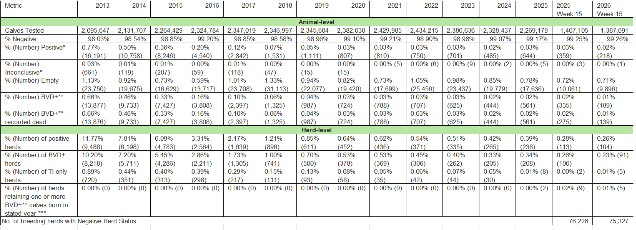
- Based on latest figures we are currently on track to achieve Legislatively recognised freedom for BVD.
- Vaccination for BVD would be prohibited if the country is to be recognised as BVD free.
- The IFA does not support applying for BVD freedom recognition if vaccination is prohibited.
- The IFA have called on the Department of Agriculture to seek amendments to the EU AHL that would allow vaccination in countries recognised as free for BVD.
- Enhancements to the BVD programme for 2026 and 2027 are under discussion at the BVDIG.
- Postage has been an issue in 2026. AHIs BVDIG are working with co-ops and An post to come up with a solution prior to the 1017 calving season.
Johnes
AHI on the 6th of February launched a new scheme for farmers that have shown 2 BMT positive in the last three years. The National Johnes Monitoring Scheme (NIMS) will provide funding for these farmers. The proposed funding is €550 in year one, €150 in year two, €550 in year three and €150 in year 4. The funding is to cover the cost of two vramps and some of the cost of testing.
National Veterinary Prescribing System (NVPS)
The NVPS has been fully enacted since the 1st of December 2025. DAFM will provide a full prescription on AIM and a more detailed text message for farmers.