Animal Health Council Report February 2026
Bluetongue 3 (BTV 3)
A case of BTV3 was confirmed in routine slaughter surveillance in an animal from a farm in County Wexford on 23rd January, the farm is located on the coast.
It is disappointing the disease has entered Ireland but not surprising given the extent of spread across Europe, England, Wales and into Northern Ireland.
The disease was most likely introduced in wind borne midges in the September to early November period last year
None of the positive animals had shown any symptoms of the disease
Testing is been carried out in the region up to 20km from the initial outbreak.
Some movement restrictions are in place on farms with positive animals, but DAFM have not implemented any movement restrictions on any other farms.
All other farms in the country can continue to move and market livestock as normal.
All marts and factories will continue to operate as normal
The disease can only be spread between animals by midges
The lack of vector activity and low temperatures prevent spread of the disease currently.
Farmers should remain extremely vigilant and report any concerns to their PVP and/or local Department of Agriculture office and not move any animals if there is suspicion of the disease on the holding
There is no food safety or human health implications from this disease.
Trade
- The majority of milk and meat export markets are not affected
- Confirmation of BTV3 in the country does have some implications for the Live export trade depending on the country of destination.
- All EU countries have arrangements in place and will continue to accept live animals from Ireland with some countries requiring additional testing, vaccination, quarantine etc.
- The Netherlands, Spain, Belgium, Croatia, Czech Republic, France, Germany, Hungry and Luxembourg have no additional requirements for live trade while Italy and Portugal have no specific requirements for BTV if the same serotype is present in the region of destination.
- Only animals direct for slaughter can be exported to NI. IFA have met with the Department of Agriculture and twice with the UFU to advance the trade of feeding and breeding animals.
- Other international trade certs must be amended; these are currently being worked on.
Vaccination
Vaccinations can be administrated by farmers and can be given to selected animals within the herd, i.e. you are not required to vaccinate the entire herd if you do not wish to.
Vaccines are approved for use in the country and are available.
There is a licencing process for use as these vaccines are approved under emergency use authorisation.
PVPs must obtain a licence from DAFM to prescribe BTV vaccination and add farmers wishing to vaccinate onto this licence.
This process is taking approx. 2 days at present
Farmers considering vaccination should discuss their individual circumstances with their PVP
There are currently stocks of one of the vaccines in the country.
High vector season is from May to October; vaccinations should be timed to ensure onset of immunity prior to the high vector period.
TB
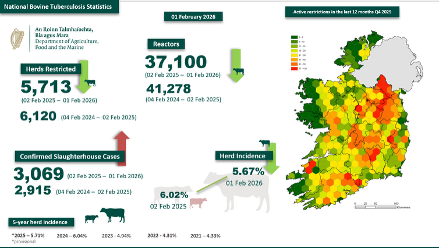
- The TB Action Plan was launched by the Minister for Agriculture, Martin Heydon, on the 9th of September 2025. While the plan represents an important step in tackling bovine TB, the Irish Farmers Association has raised concerns that it lacks sufficient detail on how the proposed measures will operate in practice or be implemented at farm level.
IFA response:
- There is significant progress in proposals to address wildlife in the ‘Plan’
- However, some measures will be very difficult on famers and must be quantified
- There is more detail needed from DAFM on some of the proposals
- The ‘Plan’ will not reduce TB levels if funding and resources are not provided to implement the programme effectively and consistently throughout the country
- All compensation schemes must be reviewed for fitness for purpose
- The First issue for the Minister to resolve is the outdated arbitrary ceilings of €3,000 and €5,000 in the live valuation scheme
BVD
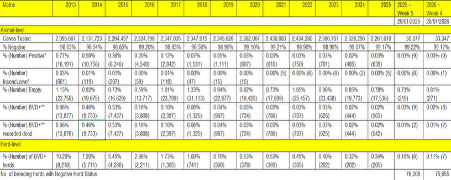
- Based on latest figures we are currently on track to achieve Legislatively recognised freedom for BVD
- Vaccination for BVD would be prohibited if the country is to be recognised as BVD free
- IFA do not support applying for BVD freedom recognition if vaccination is prohibited
- IFA have called on the Department of Agriculture to seek amendments to the EU AHL that would allow vaccination in countries recognised as free for BVD.
- Enhancements to the BVD programme for 2026 and 2027 are under discussion at the BVDIG
IBR
The funding model remains the critical issue that must be addressed to advance a programme. AHI are considering a voluntary programme to be launched this year in advance of the deadline imposed for importation of live animals by the Dutch Government.
Johnes
AHI on the 6th of February launched a new scheme for farmers that have shown 2 BMT positive in the last three years. The National Johnes Monitoring Scheme (NIMS) will provide funding for these farmers. The proposed funding is €550 in year one, €150 in year two, €550 in year three and €150 in year 4. The funding is to cover the cost of two VRAMPs and some of the cost of testing.
National Veterinary Prescribing System (NVPS)
The NVPS has been fully enacted since the 1st of December 2025. DAFM will provide a full prescription on AIM and a more detailed text message for farmers.